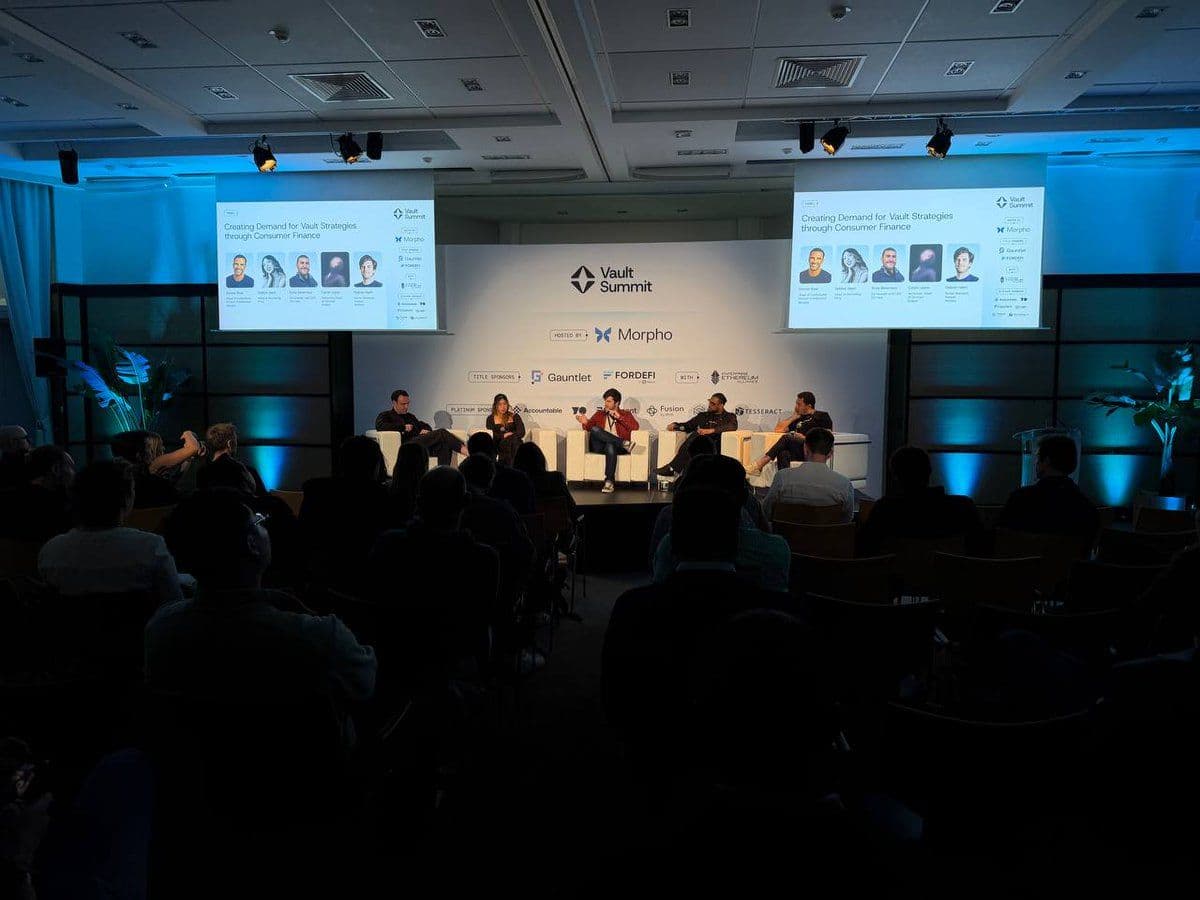
Vault Summit in Cannes drew Apollo, Bitwise, Franklin Templeton and fifty other speakers to Hotel Barrière Le Majestic for eight hours of institutional DeFi that felt nothing like a typical crypto conference.
The Hotel Barrière Le Majestic sits on the Croisette in Cannes, the kind of venue you associate with film premieres and champagne receptions. On 1 April, it hosted something rather different: fifty speakers, eight hours of panels, and a room full of credit analysts, risk managers, and protocol engineers arguing about vault architecture. No meme coins. No influencer panels. No shilling. Vault Summit, organised by Morpho during EthCC week, was the most focused institutional DeFi event I've attended, and the clearest evidence yet that this corner of the industry has grown up.
The day's thesis was set early by Paul Frambot, Morpho's CEO. His argument was structural rather than promotional: a single DAO cannot underwrite lending markets for seven billion people, and attempting it would be, in his word, "dystopian." The alternative is the curator model, where vault infrastructure provides the rails and specialist asset managers provide the strategy. This is Morpho's business model, and Frambot is hardly a neutral observer, but the evidence in the room made his case for him.
Steakhouse Financial manages approximately $2 billion in vault strategies on Morpho. Sentora (formerly IntoTheBlock) scaled to $150 million in eight weeks after launching its partnership with Kraken Earn. Gauntlet oversees $1.3 billion in vault TVL. Bitwise, the $15 billion-plus asset manager best known for its ETF products, has assembled a dedicated vault curation team led by Jonathan Mann, a 17-year TradFi credit veteran. These are not pilot programmes or proofs of concept. They are operating businesses managing real capital through on-chain infrastructure, and the numbers are growing fast enough that the "institutions are coming" line, a crypto conference cliché since at least 2019, finally has some substance behind it.
The single most striking moment of the conference was not a keynote but a fireside chat. Christine Moy, who leads digital asset strategy at Apollo Global Management, sat down with Frambot to discuss on-chain credit origination. Apollo manages $900 billion in assets. Moy wasn't there to explore or to observe; she described concrete work being done on Morpho's infrastructure. A $900 billion asset manager discussing specific lending mechanics with a DeFi protocol founder: two years ago, that conversation would not have happened.
It wasn't just Apollo. Figure Technologies announced it would bring $22 billion in tokenised home equity lines of credit to Ethereum via Morpho, with Sentora handling curation. Bitwise is actively exploring wrapping vault strategies into ETF wrappers for distribution through traditional brokerage accounts. Franklin Templeton, which has been building its own blockchain infrastructure in-house, participated in a panel on tokenised money market funds competing with DeFi vaults for the same base yield. The calibre of institutional names at Vault Summit was a step change from anything the DeFi conference circuit has produced before.
But the conference was not all optimism, and the most valuable session may have been the most uncomfortable. Mehdi Lebbar, co-founder of YO Labs and a former Credit Suisse investment banker, delivered a solo presentation on DeFi yield sources that doubled as a warning. He described receiving dozens of pitches for private credit products where he could not understand where the yield was coming from, and then drew an explicit parallel to the pre-2008 financial crisis. "Back in 2007, I was an investment banker at Credit Suisse," he told the room. "We went through the great financial crisis because we didn't understand where the yield came from. And here we have the same issue."
The private credit warnings came from multiple directions. Gabriel Halm at Sentora distinguished between tokenised treasuries (clear counterparty risk, sound custody) and tokenised private credit, where quarterly audits are the best transparency most investors can hope for. He noted that BlackRock has blocked redemptions on certain products and asked what happens when that dynamic cascades into DeFi. Jeroen Offerijns from Centrifuge pointed out that ERC-7540, the asynchronous vault standard he co-authored, was designed specifically to handle the redemption timing problems that private credit introduces. The anxiety was real, and it came from people with operational skin in the game. Vault curators and protocol builders who will be the first to suffer if opaque credit blows up on-chain.
The $25 million Resolve exploit, which occurred roughly a week before the conference, sharpened every risk discussion. On the managing-vault-risk panel, Giel Detienne from KPK described running over 300 monitors across smart contracts, beacon chain slashing events, and multisig changes, all connected to automated exit agents. Alexis Bourdillat from Steakhouse Financial confirmed they had avoided the toxic RLP tranche entirely through due diligence and exited their small remaining USR exposure within minutes of the exploit, thanks to automated incident response. The Resolve event happened at 2:20 a.m. on a Sunday morning in DC. Slack alerts alone don't cut it anymore. Automated action is now the minimum standard for any vault curator that wants to be taken seriously by institutional allocators.
Regulatory compliance ran through nearly every panel. Stéphane Daniel from DNA Partners delivered the bluntest legal assessment of the day: a curator working on DeFi with the public on a permissionless basis going into MiCA is "not possible." Three distinct compliance models emerged. Tesseract presented its regulatory compliant vaults solution for institutions: vault-level KYC, single-client segregation, non-transferable vault tokens, and licensed services under MiCA. Darren Camas from IPOR Fusion, Tesseract's technical partner, called it "what I believe is the first MiCA-compliant asset manager and infrastructure stack going live." SG Forge described an alternative: compliance through underlying asset monitoring and contractual curator relationships, without imposing vault-level KYC on end users. Most curators, however, remain in what Daniel described as a grey zone, operating without explicit authorisation and hoping the "fully decentralised" exemption holds. It won't hold forever. The first enforcement action will reshape the competitive landscape overnight.
The stablecoin thesis underpinned everything. Hong Kim from Bitwise named it directly: "We believe in the stablecoin super cycle. It's very obvious that this is where we should be." As dollars convert to stablecoins, they need on-chain asset management, and vaults are the infrastructure for that. Spiko demonstrated what production-grade institutional infrastructure looks like when it actually works: an EU-approved on-chain money market fund with block-by-block yield accrual across ten-plus blockchains, handling hundreds to thousands of daily subscriptions and redemptions. Not a pilot. A live system processing real flows.
The bottleneck, as multiple speakers acknowledged, is no longer technology. It is distribution. Morpho's strategy is B2B2C: embedding earn and borrow products into wallets and exchange apps through integration partners like Privy, Dynamic, and Turnkey. The exchange side is already moving. Several large venues in the US and Asia are linking non-custodial wallets to the exchange UX so that users allocate to vaults without feeling like they've left the platform.
One tension the conference surfaced without resolving: transparency versus privacy. The risk panels demanded maximum visibility into vault operations and curator decision-making. Minutes later, Shiv Shankar from Boundless Networks argued that most institutional capital "can't afford to be visible" and needs confidentiality layers before it will touch DeFi. Lancelot de Ferrière from Hyli proposed a middle path using zero-knowledge proofs for selective disclosure, letting institutions prove compliance without exposing positions. Both sides made compelling arguments, and both cannot be fully satisfied simultaneously. How the industry resolves this will determine whether the next $100 billion of institutional capital arrives in years or in decades.
Gaps remain, and the conference was honest about them. Fixed-rate lending is the single biggest structural blocker for institutional adoption. Institutions need fixed rates for accounting, tax, and forward planning, and the current variable-rate vault architecture cannot provide them. Morpho announced TBA (time-based allocation) as a step towards solving this, but it isn't live yet. Vault insurance coverage sits below one per cent of DeFi's total value locked; OpenCover's current cap of $50 million per vault is orders of magnitude below what institutional allocators require. And no standardised vault rating framework exists, though Credora's early work reportedly drove $200 million in inflows to Spark after it published ratings — suggesting the demand for credible risk assessment is enormous and largely unmet.
Merlin Egalite, Morpho co-founder, closed the day by saying that vaults will be "one of the biggest disruptions in finance." After eight hours in that room — watching Apollo discuss credit origination mechanics, Bitwise plan ETF wrappers, Steakhouse demonstrate automated exploit response — the statement didn't land as hyperbole. It landed as a schedule.